THE HEDGEHOG DEFENSE
A Tactics Tested Across Three Continents

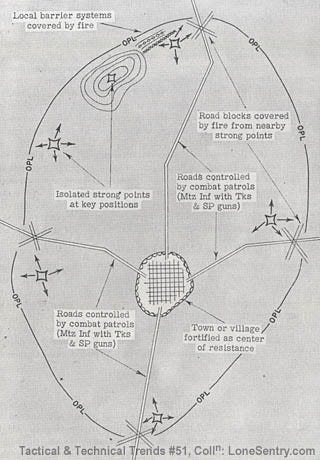
The hedgehog, or all‑around defense, was extensively used in World War II on Germany’s Eastern Front. The Germans first encountered the concept during the French Campaign of 1940, when the French employed it in the final phase of the battle; too late to influence the outcome, but effectively enough to demonstrate its potential. The idea emerged as a response to the growing mobility and firepower of mechanized warfare: a continuous defensive line was too brittle, whereas dispersed strongpoints forced the attacker to fight multiple small battles instead of achieving a single breakthrough.
Hedgehogs were designed not only for defense but also for launching local counterattacks. They were deployed in depth and arranged to provide mutual support. Because they were costly to assault directly, attackers often attempted to bypass them, exposing themselves to enfilading fire as they passed between strongpoints, frequently followed by counterattacks against their flanks or rear.
By the summer of 1943, the Germans abandoned this concept in favor of a more linear defense. This shift reflected not only severe manpower shortages - especially the loss of experienced veterans - but also the increasing Soviet ability to conduct deep, coordinated operations. Once the Red Army achieved operational penetration, isolated strongpoints could be bypassed, cut off, and neutralized more easily than before, turning them from assets into liabilities.
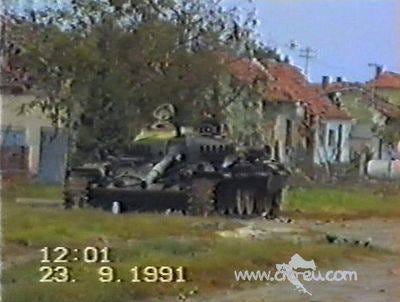
The hedgehog scheme was later employed twice by the French in Vietnam: at Na San, where it worked effectively, and at Dien Bien Phu, where it failed catastrophically. In the Second Indochinese War, the Americans used similar tactics, although against their wishes, with considerable success at Khe Sanh. A comparable approach appeared in the 1991 Battle of Vukovar, where a small Croatian garrison held out for three months against the vastly superior force composed of the Yugoslav Army and Serbian volunteers, buying time for a strategic defense in depth to be organized.
In every theater, the hedgehog defense proved highly effective when supported by mobile reserves and adequate firepower, but fragile when isolated or unable to counterattack.