THE RAID ON FORT LAMY
How One Airplane Can Make A Difference

In February 1941, with the arrival of the German army in Africa, the character of the desert war changed. The situation in the Mediterranean shifted as well: despite holding Gibraltar, Malta, and the Suez Canal, British control was steadily eroding, especially after the Luftwaffe X Air Corps arrived in Sicily. Faced with a German offensive in the air and in the desert, the British developed alternative supply routes for their Egyptian army in the coming months. One of the new African supply routes began in the port of Douala, ran through Fort Lamy, and continued toward the Nile Delta. Fort Lamy, in the Lake Chad region under Free French control, became a major junction and a vast depot from which accumulated war materiel moved eastward. The Germans knew nothing about this until the end of 1941, when the adventurer and Luftwaffe officer Theo Blaich proposed capturing this important hub. As there were more than 2,000 kilometers of desert between F. Lamy and the Italian-German forces in Libya, the idea was rejected. Nevertheless, Rommel felt that something should be done to this supply route, and authorized Blaich to form an ad hoc air attack unit.
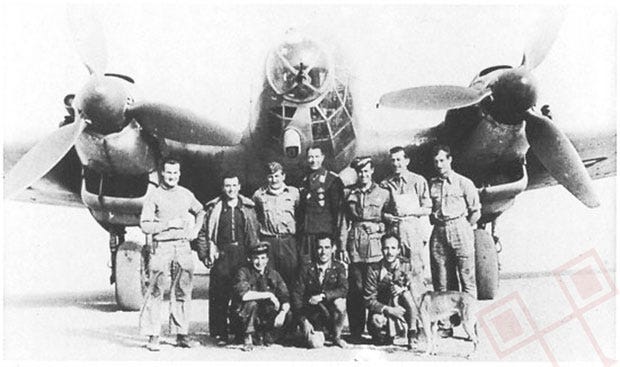
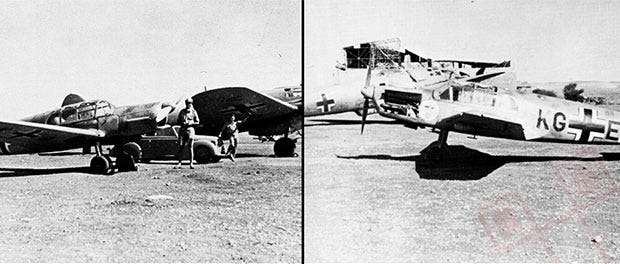
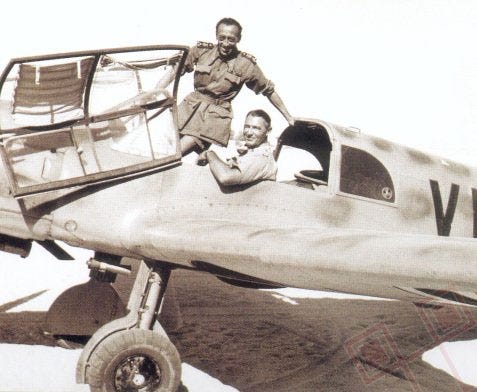
This special air unit was called the Sonderkommando Blaich and consisted of three aircraft: an Italian Savoia and a German Messerschmitt Bf 108 Taifun (Blaich's private plane), and a Heinkel He 111. The bombing itself was to be carried out by a Heinkel, whose crew, in addition to Blaich, consisted of four other Germans and an Italian desert expert, Major Roberto Conte Vimercati-San Severino. The three aircraft left the Hun oasis on 20 January 1941. They flew to the airfield (actually, an area of flat, rocky desert that Vimercati-San Severino had discovered before the war and precisely marked on a map) of Campo Uno in southern Libya. The attack was to happen the next day, to coincide with the start of Rommel's new campaign.
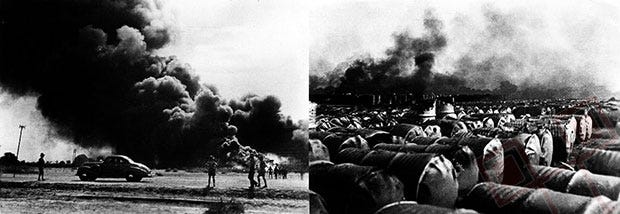
The mission began at 08:00 on 21 January 1942, with a Heinkel taking off from Campo Uno. At around 14:30, the attackers arrived over Fort Lamy and, undeterred by anti-aircraft fire, carried out a precision bombing raid that destroyed around 300,000 litres of high-octane aviation fuel; the entire oil supply and a dozen aircraft. On the way back, Blaich and his team ran out of fuel due to a navigational error and had to make a forced landing in the desert, about 200km south of Campo Uno. The situation was not rosy, as they could not contact their own people and had only six days’ worth of supplies. After two days, they managed to contact the command, but it took another three days for an Italian reconnaissance plane to discover them! They were rescued on 27 January, a few hours after they had shared the last drops of water!